We meet Marta Esteban and Adrià Crespo, one of the five duos from the Lied the Future 2026 programme performing at the Schubertíada this August
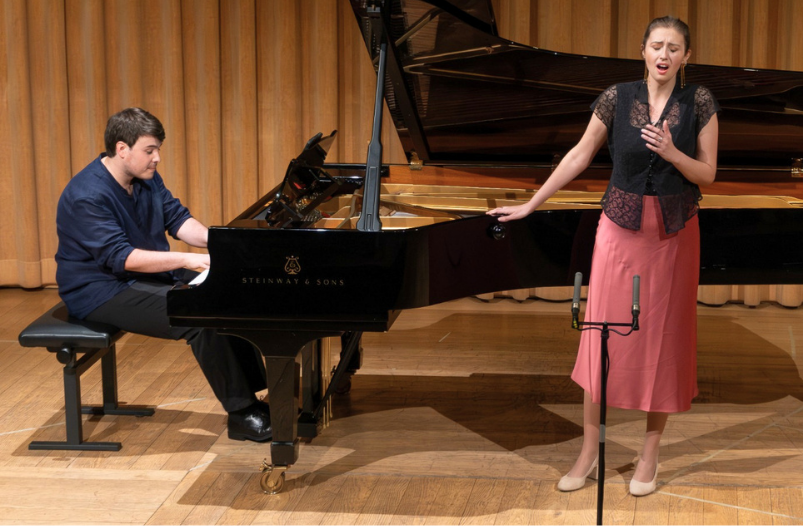
Soprano Marta Esteban and pianist Adrià Crespo form one of the five winning duos of the Lied the Future 2026 programme, promoted by the Franz Schubert Association with the support of the Fundació Ferrer de Música. The programme aims to promote emerging talent and contribute to the development of new artists specialising in the lied repertoire. Both artists have completed their training at prestigious institutions and specialised programmes and have developed careers focused on recitals, chamber music and vocal repertoire.
On 20 August at 5:30 p.m., Marta Esteban and Adrià Crespo will perform at the Canònica de Santa Maria de Vilabertran, as part of the Schubertíada, one of the world’s leading festivals of lied and chamber music. The concert will bring them together with the duo formed by mezzo-soprano Katharina Bierweiler and pianist Jyri Mishukov, in a programme that will allow audiences to hear two of the five winning duos of Lied the Future 2026 in an emblematic setting in the Empordà region.
– What led you to study lied, and what do you find most fascinating about this musical genre?
Adrià Crespo: For a pianist, it is a really new world to perform as a duo with a singer, at least in terms of our training. We are very focused on our repertoire as solo pianists. It wasn’t until my second year at ESMUC that I came into contact with this format, the combination of voice and piano known as lied. Once I discovered it, I realised how much it could offer me in terms of expression and the opportunity to work with such a different instrument as the voice.
– Marta, when did you decide that vocal performance would be your professional path?
Marta Esteban: I started studying singing quite late. When I was younger, I wasn’t sure about it. In fact, I studied a completely different degree: industrial design. But I had studied music from a very young age; I started with the piano. And I gradually became involved in the world of choirs. Music had always been present in my life, but I had never thought of making it my career. Just after finishing my degree, I knew I wanted to continue studying, whatever it was. I wanted to study architecture or engineering. I had many ideas. When I joined a choir with Anaïs Oliveras, a fantastic teacher and singer, she said to me, “Why don’t you make a career out of it?” And I thought, “Why not?” It happened somewhat by chance. It’s true that music had always been a very important part of my life. It was a last-minute decision, but now I am 100% dedicated to it.
– And what happened to industrial design?
ME: I kept up with industrial design for many years. I worked designing street furniture for a long time. But that’s it now. It’s very difficult to combine the two things. I have also worked, and still do, as a freelance graphic designer, but only when it gives me the flexibility to sing.
– How did this duo come together?
AC: The most special thing is that we began our musical training together, studying for our professional degree at the Conservatory of Terrassa, where we are both from. We started out as classmates and, unofficially or informally, we took part in many projects together. We also spent many holidays together. We gradually developed this chemistry around music. It wasn’t until we had the opportunity to take part in the international course taught by Professor Wolfram Rieger at ESMUC that we really considered establishing ourselves as a lied duo and trying out this first collaboration together. From there, this new opportunity came along, which basically expands the boundaries of our friendship and also of our career together as musicians.
ME: Another interesting thing is that, in many cases, when you work in music, you make many friends. Making music is a very social activity. What’s interesting about this duo is that we wanted to work together. It’s not a friendship that emerged from working together; we work together because we were already friends, which isn’t that common. In fact, we could have taken the course Adrià mentioned with any other musician we’ve worked with, because we’ve worked with many other people, but we knew we wanted to do it together, to make music with friends. And I think that’s really special.
– I’m sure that chemistry also comes across to the audience…
ME: That’s what we were recently told after a concert: that it was clear we were completely in sync.
– What led you to apply for the Lied the Future programme?
ME: Our idea is to professionalise this duo. We believe we can explore many possibilities together. Above all, I think we understand each other very well expressively. The truth is that we haven’t had another opportunity to take this into the professional world, and this is our first option. As soon as we joined the course Adrià mentioned, we said we had to give it a try. And working at the Schubertíada is a dream for us in many ways. Adrià said that lied isn’t as common in the piano world, but for singers it is part of our training. So for us, it was a necessary option.
AC: In a way, it has been the first opportunity we’ve come across since we decided we wanted to professionalise ourselves. When we saw it, we thought, “This could be a really great opportunity to start this journey.” And that’s why we applied.
– How did you feel when you were told you had been selected for the programme?
AC: We couldn’t believe it. I also remember that I was working at the time and I saw a call from Marta and thought, “Why is she calling me?” Given the dates, it could have been the Lied the Future results. And it was: she was calling to give me the greatest, greatest, greatest news.
ME: We were very happy with what we had submitted. But, as they mentioned at the press conference presenting the Schubertíada, there was a huge number of applicants and there were people who had done very well. This is a really competitive field. And we think it’s an incredible opportunity. We are very happy.
– What do you hope to learn from the teachers and mentors taking part in this edition?
AC: I’m still discovering many things about this world and this musical genre. I really learn a lot from Marta and from our work together. And these professionals, these teachers and artists who have been dedicated to this field for many years, can share all their experience of what a musician working in this sector really needs. One thing is clear to me: a pianist who specialises in lied needs to develop skills that aren’t acquired in other fields. With these teachers, I will discover what I need to learn in order to really succeed in this genre.
ME: Also, in both our cases, our educational stage has ended or is coming to an end. It hasn’t been that long since we finished our degrees. During your studies, you play a little bit of everything, but it’s very difficult to specialise. It’s hard to find environments that give you the opportunity to specialise. So being able to work with professionals who have been specialising in lied for many years is a very valuable opportunity. This programme can therefore be incredibly enriching.
– What does it mean to you to be able to perform at leading festivals such as the Schubertíada?
AC: Well, we’re fans of this festival. For me, the Schubertíada is that milestone, that place where the people we admire perform. Being able to train within this setting and share the stage with all these people seems almost impossible. It’s incredible.
ME: And beyond the Schubertíada, having the opportunity to perform at other festivals and present everything we will have worked on with these specialists, to reach other people, is a very interesting learning experience. This is another very positive aspect of Lied the Future: it really supports the idea that this duo shouldn’t end with the Schubertíada, but should be able to continue working, training and professionalising itself.
– Where do you see your careers in five years’ time?
ME: In my case, I would like to work in many different fields. It would be a dream to perform lied, concerts of oratorios, opera… To be able to do a bit of everything. If I can do that in five years, I will be very grateful, because musically, every environment can offer you very different things. That would be fantastic for me. And in the world of lied, I would like to continue working. What we are doing now at the Schubertíada, hopefully I can do again next year, and the year after, and the year after that. Yes, to keep working.
AC: For me, this diversification would also be very rewarding. I’ve spent many years working on solo piano repertoire and I think it has given me many tools, but I lack this more transversal, interdisciplinary perspective that working with instrumental ensembles, chamber music, trios, quartets… could give me. Expanding this repertoire into lied… In five years, I imagine myself being able to serve music in whatever way I can contribute something, and where the project can also contribute something to me.
– Marta, in your particular case, you have been a recipient of the Ferrer-Salat Scholarships and this year you are also a winner of the Lied the Future programme, promoted by the Franz Schubert Association with the support of the Fundació Ferrer de Música. What has this support meant for your training?
ME: For me, receiving the Ferrer-Salat Scholarships throughout my degree and training was above all an economic opportunity, because I was already living independently, and being able to count on this support was fantastic. Studying music requires many hours that, as people who have to make a living in this society, you have to take away from work. To be able to take your first steps in the world of music, which isn’t easy, was incredible. I feel very grateful.
ARTICLES RELACIONATS