Liceu Jazz Opens the Door to Musical Dialogue Between Andrea Motis, Yamandu Costa and Conservatori Liceu Students
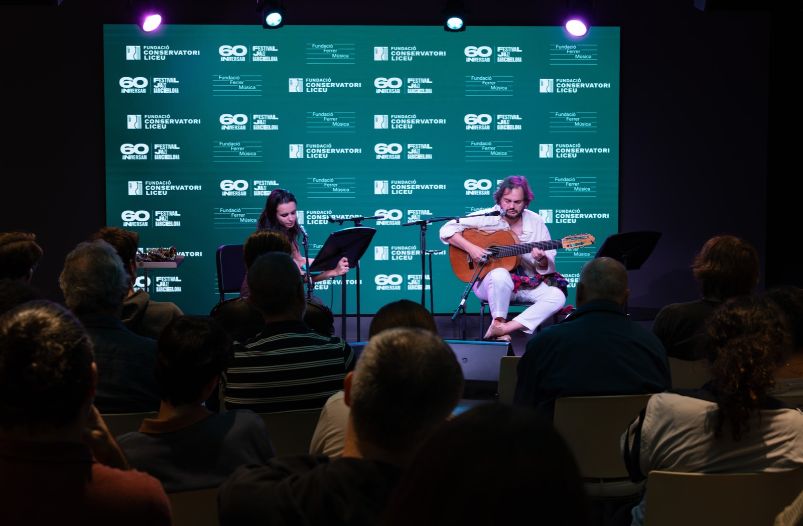
Some musical encounters begin long before the stage lights come on. At the Conservatori Liceu's Live Room, Andrea Motis and Yamandu Costa have shared an open rehearsal with students, offering a space where music is revealed as it unfolds. On the eve of their first concert together at the Palau de la Música Catalana, the duo offered a privileged glimpse into their creative process, giving aspiring musicians first-hand insight into the experience of building something unique on stage.
The encounter was made possible thanks to Liceu Jazz, a programme promoted by the Fundació Ferrer de Música, the Fundació Conservatori Liceu and the Barcelona Jazz Festival, which offers masterclasses, open rehearsals and concerts to bring conservatory students closer to the artists performing at this major jazz event. Beyond sharing knowledge, Motis and Costa championed music as a living language, one learned as much through listening as through theory, and one that demands curiosity, concentration and trust in one another. Between the sensitivity of the Catalan trumpeter and singer and the exuberance of the Brazilian guitarist lies the promise of a collaboration that is only just beginning and that, as they themselves sense, is destined to cross borders and musical styles.
– Today you shared a rehearsal with students from the Conservatori Liceu. What do you think they took away from this experience?
Andrea Motis: I think it was like a behind-the-scenes rehearsal, similar to the rehearsal we previously had at my house, so they got to see what a rehearsal is really like, something very real and informal. We also tried to give it an element of a concert, with songs we both enjoy. The students asked some very interesting questions. We also talked about how to connect through music, about things that really matter. We discussed improvisation as spontaneous composition and other very interesting ideas that Yamandu had already shared with me. I’m really glad these topics came up so we could share them with the other students.
Yamandu Costa: It’s a very important opportunity because it pushes you to do your very best. When you rehearse at home, you’re more relaxed and sometimes you don’t concentrate as much, but when you have someone else’s attention, you have to give it your best. In a way, it also reassured me a little, because I feel we’re going to enjoy ourselves and show something genuine, something real and original. I’m very happy to have this opportunity to make music with Andrea. I think we’re starting something that will leave a beautiful mark along the way.
– The Liceu Jazz programme, organised by the Fundació Ferrer de Música, the Fundació Conservatori Liceu and the Barcelona Jazz Festival, offers masterclasses, concerts and encounters with leading jazz figures, bringing these musical role models closer to conservatory students. Why do you think it is important for young musicians to have opportunities to share experiences with artists like yourselves?
YC: I think it’s important to demystify things and reduce some of that distance and formality. It helps show that music is created in the moment. The first time, you always have to stay focused, try to make connections happen and let the music smile at you. So it’s a very important opportunity for them and for us too, to challenge ourselves and do our very best.
AC: I don’t know whether we manage to demystify things, but in any case, it’s wonderful, especially considering that we’ll be performing at a venue like the Palau de la Música, which is very large and feels more distant. Being able to play here, in the Conservatori Liceu’s Live Room, in such an intimate, acoustic setting, is really beautiful and very special.
– Jazz places great importance on improvisation and dialogue between musicians. How can that be taught?
YC: In American jazz, they developed an entire teaching methodology, a way of explaining and standardising improvisation, but this way students can also see that we’re creating music in the moment. I think it’s interesting, at a time like this, with AI and new technologies, to show that this way of making music is already a revolution for your own senses. These are enormous challenges: mental challenges, concentration, mastery of your instrument and achieving a beautiful connection so that you can reach people with music that is genuine and meaningful. It shouldn’t be something just for yourself, but something to be shared. It’s important for them to see that this way of making music still exists. For me, music has always been a language of the future, a doorway that leads you to discover very different things.
AM: I like to think that both Yamandu and I are examples of people who have trained their ears more than they’ve studied theory. Yamandu, despite the incredible level he’s reached, has this in common with many musicians. Sometimes, at a conservatory, you’re very focused on theory, and you’re at a stage in your life and musical development when it’s very present in your everyday routine. But it’s also interesting to learn how to connect with other musicians because, ultimately, in the language of jazz, listening is the most important thing. Music is, in the end, a more practical language than a theoretical one. Theory should simply help, and it isn’t even essential. You trust your ear and your memory. You choose to remember — or not to remember! — but above all, to experience it. Yamandu is a great example of this, and I myself also studied this way with Joan Chamorro.
– After this dress rehearsal, you’ll be performing together for the first time at the Palau de la Música Catalana. How did this collaboration come about?
AM: I was really excited about it. Joan Anton Cararach, the director of the Jazz Festival, suggested it to me, and it was as if he’d read my mind. It was something I was really looking forward to because Yamandu is a great master. Having him accompany me is a dream. He’s a genius. He’s like an entire orchestra in one person. He has this virtuosity, but he’s also sensitive and eclectic, with so many wonderful musical qualities that I immediately wanted to play with him. It wasn’t possible last year, so we kept postponing it until tomorrow, when it will finally happen.
YC: I think this is the beginning of something because we have so much in common. I’ve started to see all sorts of possibilities for what we could do together, beyond borders and musical styles. We share a lot of common interests, such as beautiful music and the popular musical traditions of different places, which we can interpret in an original way, with authenticity and from the heart.
ARTICLES RELACIONATS